Tuesday, March 22, 2011
Week 11 - Final Evaluation
Overall I feel that the Fundamentals of Advertising course has in fact furthered not only my interest in advertising in general, but also has definitely increased my knowledge on the subject. With my business and brief marketing experience, I knew that advertising is not as easy field in which to be successful. The creation of advertisements almost has a scientific quality meaning that while they need to be creative and catchy, there are many formulas and considerations that need to be taken in order to make them effective, not just throwing a funny quote on the page in a ‘cute’ font. This class has enabled me to examine these qualities from composition, to line, to symmetry and begin to evaluate why and how an advertiser may have come up with the ad that they did. Being able to read in the book and learn from the experience of industry giants who contributed their thoughts and work was extremely helpful as well. In an area of business such as advertising that is very subjective, it was a great help to learn about the different perspectives of people who are of great importance in the field. Overall I feel that the class has helped me gain a stronger understanding of advertising, and how one should, and may, come up with different forms of advertisements for a product. The creation of our final project was the epitome of this understanding by forcing us to think creatively and market a product that is already on the market, something that a real ‘ad man’ would have to do. I think that my successful creation of this advertising campaign, the creativity behind it, and my overall contributions to the class throughout the quarter entitle me to earn an A in the class.

Tuesday, March 8, 2011
Week Nine EOC - For Those Who Think Young
America has always been a youth obsessed culture. The idea of getting older, being bedridden, and forced to live in a retirement home has never appealed to anyone in our society. In fact, we loathe the idea so much that we do in fact put our parents, who raised and cared for us, in retirement homes for nurses to take care of rather than ourselves. There are cultures in the world, mainly in Asia, where we are looked upon with loathsome eyes for doing such a thing, in their society elders are respected and often live at home with their families until the day they pass. As we grow older we drastically change our eating habits, constantly sweat away at the gym, and even take injections and vitamin supplements all in the hope of retaining our youthful demeanor. Older employees at firms are usually looked upon with pity and let go before their younger peers if job cuts need to be made, usually forced into early retirement or just let go. But why have we been obsessed with youth? Why do we allow it to run our country and our lives?
The striving for youth is not a new phenomenon. In fact "In 1,500 B.C. people were ingesting tiger gonads to rejuvenate them," says Dr. Gene Cohen, a George Washington University expert on aging. (USA Today) We are constantly searching for a way to prove that we are healthier and more vital than our parents were at our age. 50 has become the new 60 and then 40 became the new 50 just as quickly as the 4 (dress size) became the new 6 and then 2 became the new 4. Our society has constantly been bombarded with ideals of beauty and health for ages and in the current age of magazines and internet it has been happening more constantly than for other generations. But at what cost to our health are we striving to stay young? Is all this plastic surgery and injections and dieting really helping us?
Do not misunderstand me, I will get botox injections tomorrow if I see a wrinkle on my forehead. I plan on having plastic surgery at some point in my life and would love to have jaw implants now. I, as a young, affluent, gay male in our society have been completely consumed by the idea of youth as beauty. Particularly in the gay community, where at 22 I might as well be 55, these impossible beauty ideals thrive and spread into all areas of one’s professional and personal life, and eventually to those around them.
Week Nine BOC - Frank O'hara
Frank O’hara was an American poet and art critic who was born in Baltimore, Maryland and was one of the New York School of Poetry. He first studied piano at the New England Conservatory before being drafted to the Navy in WWII and serving in Japan and the South Pacific. Upon his return he utilized the scholarships offered by the government to attend Harvard where he was majoring in composition and music but his interests began to wane. He began taking theology and philosophy classes and began writing in his spare time. He changed his major and graduated with a degree in English and went on to study at graduate school at the University of Michigan Ann Arbor.
In his poem, Mayakovsky, I think that O’hara is referring to his time as a soldier and his yearning for knowing what that has done to his psyche. I think that at the beginning of the poem he is reminded of when he was a little boy, perhaps getting ready for bed at night, wondering where his father was. He wanted to see his father one last time before he went to bed. He then goes on to say “That’s funny, there’s blood on my chest, oh yes I’ve been carrying bricks, what a funny place to rupture.” He has now transitioned to war time, he has blood on his chest and the bricks are the baggage from home that he brings. Everyone who I believe goes to war begins to revert back to old distant memories in order to escape the painful images they are seeing around them. This poem may have some relevance today with the onslaught of America’s “War on Terror” but has no personal resonance for me. My father was always home at a reasonable hour, due to not having an extremely long commute to work, and I have never seen the spoils of war. The poem itself is still poignant and beautifully written and I think that I understand what he may be searching to say, but I could not feel nor convey the emotions that he expresses myself.
Tuesday, March 1, 2011
Week Eight EOC -- Slogan Fonts
Luxury is never out of place
Luxury is never out of place
Luxury is never out of place
Luxury is never out of place
Luxury is never out of place
Luxury is never out of place
Luxury is never out of place
Luxury is never out of place
Luxury is never out of place
Luxury is never out of place
Analysis of Project in Real World
With so many advertisements being bombarded at consumers at an almost constant basis in this day and age, it is more difficult for advertisers to reach their target market than it ever has been before. What then makes an effective advertising campaign and how can in be labeled as successful? “Not only do you need to think critically about formulating a core campaign idea, you must think critically and creatively about communicating something specific about the brand or group, not a generic message or pedestrian design.” (Advertising by Design; Landa, Robin; 204). The Luxury is never out of place advertising campaign encompasses all of the ideas that would make an advertisement successful, not only to those that already want to purchase the vehicle but to those who had not previously thought of purchasing the 3 Series.
“A campaign must have visual impact, whether a visual surprise, graphic interest, visual drama, or a breakthrough appearance.” (Advertising by Design; Landa, Robin; 204) This will most definitely be achieved in the new advertising campaign created for the BMW 3 Series. The television commercial will be especially visually interesting with the sophisticated young woman surrounded by the roughneck country folk in the diner, and then also her beautiful white BMW 3 Series in juxtaposition with the run down vehicles of said country folk. The print campaigns will follow in this style by showing both of these visually interesting components of the ads. “Find a way to utilize something that you can create that others might not think of or utilize.” (Advertising by Design; Landa, Robin; 207) The emotional pull that is created by this new campaign is one that many may not have thought of before when trying to sell a luxury car. For many luxury cars the aspect that is focused on is their performance, though that is not what many of the consumers of such cars, especially entry models like the 3 Series, are concerned about. This new campaign has taken an overlooked quality about the 3 Series and made it the forefront of the campaign. Taking such a risk I think will make BMW stand out from the competition and gain them more of a market share.
“Throughout the life of a campaign, which can run for a short (months) or long period of time (years), you create and maintain a visual look or framework” (Advertising by Design; Landa, Robin; 199) The most successful part of the new BMW campaign will be its consistency. The main theme of the campaign will carry on throughout all of the different mediums as stated above and will ensure the advertising campaign’s success.



Competitive Analysis
BMW has taken many steps to set themselves apart from their competitors in the luxury automobile market. The closest competitors are Japanese owned Lexus and fellow German competitor Mercedes-Benz. Each company has their own approach to setting themselves apart from each other. It seems that in services being offered, and the automobiles themselves, the companies are, in all intents and purposes, equal. While there may be small differences, they are not large enough to really matter to the purchaser. At this level, most consumers are purchasing the lifestyle image that comes along with the vehicle rather than the features of the vehicle; the BMW may get a better MPG rating than the Mercedes, but at this level the purchaser is not going care about one or two miles either way. “Most competing brands are of equal quality-that is, they are parity products or services.” (Advertising by Design; Landa, Robin; 2) In this respect I think that it is the ad campaigns and way that the company portrays their product in the media.
This is why the ad that I created for the BMW 3 Series will be successful. The ads aims to tug at the heart strings of the purchaser of the car. Creating an emotional connection to the consumer is the most important step in selling any luxury item, and the Luxury is never out of place campaign will do just that in order to separate BMW from the crowd. “What differentiates a brand is how it is characterized, its visual and verbal identity as expressed in each media unit and through every point of contact.” (Advertising by Design; Landa, Robin; 52) Currently, BMWs overall slogan, Ultimate Driving Machine, is good for the motor enthusiasts who purchase the super sporty M series vehicles. The M series is built for speed and performance, but the purchaser of the 3 Series is buying a lifestyle, not a car. “The brand idea is based on an insight into the audience that makes the brand relevant to them. It must exemplify something – tangible or intangible – that people find compellingly relevant to their lives.” (Advertising by Design; Landa, Robin; 52) Both Lexus’ and Mercedes’ ad campaigns also leave much to be desired in this arena of emotional pull. Lexus states that they are in the Pursuit of Perfection, if a consumer is paying this amount of money on a vehicle I think that they will be looking for perfection, and not just the pursuit of it. Lexus has created a campaign that may be slightly working against them in their target consumers subconscious. Mercedes as well as failed to create an emotional connection, and therefore longing, for their vehicles through their ad campaigns. All the ad campaigns are similar, and include the same typeface and same sort of message, but there does not seem to be one unified slogan across the entire brand. While each vehicle may need some sort of specific advertising, when selling a lifestyle the company itself should also have some sort of overall brand message to sell to the consumer. “In an overcrowded, competitive marketplace, relevant and engaging branding can ensure efficacy for a quality product, service, group, individual, or commodity.” (Advertising by Design; Landa, Robin; 49)
The Big Idea
The Big Idea
It was George Lois, the influential advertiser in the 1960s, who once said that his creation of the big idea was not like the striking of a lightning bolt but rather the gradual build up and modification of an idea. “For many students and novices, idea generation is the most challenging stage in the process.” (Advertising by Design; Landa, Robin; 18) This is because ideas need to come from research and must be worked and re-worked before they can be finalized. “Formulating an idea necessitates research, analysis, interpretation, inference, and reflective and creative thinking.” (Advertising by Design; Landa, Robin; 18)
BMW has made itself synonymous with luxury since the company began to build cars in 1928. For many consumers, this is in fact one of the reasons that they purchase a BMW, much in the same way as they would purchase a Louis Vuitton bag or a Dior suit. It seemed logical then to make this aspect of purchasing a 3 Series a main player and utilize it in order to reach a new emotional connection with potential customers. “By focusing on the attributes of an object, person, place, character, topic or theme, product, or service, you can find a characteristic that might lead to an idea.” (Advertising by Design; Landa, Robin; 38) Many purchasers of the 3 Series are making their first foray into the luxury market of automobiles and are more than likely not purchasing the vehicle for its performance abilities. Potential customers are more than likely looking to show their upward mobility and socioeconomic status by purchasing the vehicle. With this knowledge in mind, it doesn’t make sense to market the 3 Series as a performance vehicle, but rather what it is, a luxury purchase. “It can be useful to first break the object down into constituent parts and examine the attributes of each part.” (Advertising by Design; Landa, Robin; 38) Since performance is not the first thought on the minds of potential customers, making an emotional connection with them is the way in which to convince them to purchase a 3 Series as opposed to the Mercedes C Class or the Lexus IS class.
This is how the Luxury is never out of place slogan came about. At first I thought to keep the ad in the city, with the Met or perhaps Lincoln Center as the backdrop for the woman to be getting out of her car and going to the red carpet event in casual clothing. This event however in and of itself is luxurious, meaning that her showing up in her 335i isn’t that far fetched. However take the customer back to her roots. Many of these women may have come from small town America and worked their way up to the big city. How will the car look in that sort of setting? It will still look amazing obviously and will give her an edge when she returns home, she’ll still be able to carry herself as a well studied, urban, woman. She won’t feel self-conscious and out of place in her non-descript designer clothing and luxury automobile because Luxury is never out of place.
Promotion
The placement of new advertising campaigns is probably just as important as the advertisements themselves. “An advertising campaign is a series of coordinated ads, based on an overarching strategy and closely related ideas and connected by look and feel, voice, tone, style, imagery, and tagline.” (Advertising by Design; Landa, Robin; 188) Especially when introducing a completely new campaign, the placements of the ads need to be expertly placed in order to get them the most exposure. Considerations must be taken towards the target markets, interests, what they read daily, what television shows they watch, and where else they may see advertising in their daily lives.
The most effective forms of advertising for BMWs new advertising campaign for the 3 Series may be magazines, television commercials, and website banner campaigns. “Many clients and creatives believe that repetition is crucial and so tend to prefer ‘triplets’ across media; triplets ensure viewer recognition of the brand message” (Advertising by Design; Landa, Robin; 203) The target market for the new ad campaign is going to be young females 25-35 years of age who make 75,000+ per year. These upwardly mobile individuals are coming into their own and are able to make their first big ticket item purchases. Their young age also makes them especially prone to reacting emotionally to a product. If we are to repeat the ad campaign in magazines such as Vogue and Harper’s Bazaar, as well as television shows like Dancing with the Stars and Glee, and also social websites the market visits such as Gawker.com and facebook.com, the new ad campaign will be made noticeable in almost every aspect of their lives.
“Style is a visual look and feel based on the particular characteristics that contribute to the overall appearance.” (Advertising by Design; Landa, Robin; 203) The style of all these forms of advertising must be the same. The television commercial will be the all-encompassing aspect of the campaign, the one most focused upon. All the other advertisements will spring from this one ad, print ads will be stills from the commercial and Internet banners will have the same color scheme and typeface. “Most art directors prefer consistency in imager and typeface(s) – for example, if photograpy is used in one aspect of the campaign, then it is used throughout.” (Advertising by Design; Landa, Robin; 203) This repetition will allow the target audience to begin to recognize the advertising campaign no matter in which medium they view it as they become familiar with the new advertisements. This will allow for a greater chance of BMW reaching its target market more often and more effectively.
BMW 3 Series: Slogan
Luxury is never out of place
BMW has built their entire brand image around two central ideas, luxury and quality German engineering. These two qualities have taken the company from an airplane manufacturer in WWII Germany to one of the most sought after of all luxury vehicle companies. Over time the company has tried many different forms of advertising to sell their product. In print they have done the straight forward our car is better than your car technique (Congratulations to Audi for winning South African car of the year 2006, from the winner of World car of the year 2006 - ad), they have been adventurous trying for the avant garde (You know you’re not the first - ad), and finally have the tried and true, Ultimate Driving Machine. What I am hoping to do is land somewhere in the middle, create an ad that will reach consumers on an emotional level, and help reconnect them to the values that make BMW great. “Advertising differentiates brands, groups, and causes, and ultimately sells products and calls people to action.” (Advertising by Design; Landa, Robin; 2) This is what the new campaign will focus on, separating the BMW 3 Series from its competitors.
“Part of what differentiates a brand or group is ‘owning’ a selling point, benefit, attitude or any characteristic that contributes to a distinct construct.” (Advertising by Design; Landa, Robin; 52) The premise is simple, for true luxury really never is out place. Wouldn’t most consumers always prefer to be overdressed than underdressed, drink champagne instead of cheap beer, and live in a large home on the hillside rather than a mobile home in the valley? “Commercial advertising promotes brands and commodities by informing consumers…” (Advertising by Design; Landa, Robin; 4) So we will create a commercial advertising campaign showing that the BMW 3 series is not meant to be a flaunty machine; rather, it is perhaps its modern lines and simplistic form which makes the idea of luxury never being out of place plausible. The ostentatious sports vehicles (Bugatti, Maseratti) can, and do, look out of place in almost any situation not involving the Autobahn. The 3 series however is like an impeccably well-dressed woman. She may be wearing designer clothing head to toe (without any garish logos showing anywhere) in denim, a white t-shirt, blazer, and pumps. She does not stick out like a sore thumb in the mundaneness of a shopping mall, and yet there is still something about her, the way she seems to float across the floor while walking, the exact right fit of her denim, the perfect drape of her blazer. She is not getting noticed for the vulgarity of her designer clothing but rather the simplicity of it, a simplicity that can go with her anywhere. She understands that her idea of luxury is never out of place and she will become emotionally connected with the brand. “Emotional benefit: an intangible asset based on feeling, not on a functional characteristic of a product or service. It is a response that may derive from personal significance or reward and the desire to feel good.” (Advertising by Design; Landa, Robin; 50)
Tuesday, February 22, 2011
Week Seven EOC - The Pitch
Luxury is never out of place
BMW has built it's brand upon being a luxury car company with sporting roots and classic, dependable German engineering. Nowhere is this more prevalent than in it's 3 series automobiles. The line, consisting of fluidly designed unimposing sports cars is aimed for a specific group of individuals, upwardly mobile mid 20s females. While there are men who own the car, BMW expects that most 3 series will go to women who want to live the luxury lifestyle while their male counterparts will usually choose the more expensive and more sports inspired 6 series.
Many women who purchase the 3 series are living upwardly mobile lifestyles. While not always true, many may have grown up in small towns in rural states, left to go to college and pursue a degree, and then moved to a big city and got a well paying job. These women buy a BMW as a status symbol, to show that they are grown up and are making a name for themselves. Still though, they are tied to their hometowns and are not easily separated from the small town ideals.
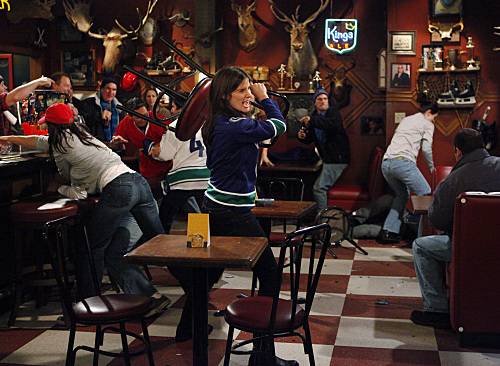
In this respect I propose a new kind of advertising campaign for the 3 series, one that will have an emotional pull for both sides of these women. The scene will be set in what appears to be the red barren desert along a classic US highway (think Route 66) at a decrepit, hole in the wall diner/bar. Seated at a booth along the windows there sits a young, attractive female with her makeup done, donning a fashionable, but unassuming, outfit (think black Louboutin pumps, dark wash skinny denim, white t-shirt, vest, and appropriate accessories). Her table has a clean white tablecloth on top of which sits flatware arranged in the continental style, a small votive of fresh flowers, and her meal including a steak and a glass of red wine. All around her are the type of roughnecks one may expect to see in the down old country, (bikers, truckers, etc) all of whom are causing a scene around her. They're throwing punches, spilling drinks, breaking windows, all while she sits unperturbed enjoying her meal. When she has finished dining and paying for her meal, she gets up to leave the diner and heads outside where there are a line of old fashioned, dented, rusting vehicles. She saunters past all these vehicles and walks directly towards hers, a perfectly pure, clean white BMW 335i convertible. She comfortably gets in the car, pushes the start button ignition, puts it in gear, and calmly drives away. Luxury is never out of place.
Tuesday, February 8, 2011
Week Five EOC -- Super Bowl Ads Good and Bad
It has happened, the biggest advertising event of the year came and passed this past weekend. All around the country friends and family gathered around their obnoxiously large televisions and watched the Super Bowl. This is like the Olympics for advertising, new campaigns and brands have been made or broken by a good or bad ad in the Super Bowl. This year the ads were mostly unimpressive. There were a few standouts such as the Volkswagon Darth Vader spot and some other effective amusing ads that were run by the usual suspects, ie Doritos and Budweiser. Its amusing to note that on the list of most like and most recalled ads that was compiled by Neilsen only two ads, both for Doritos, made the top 10. One of these commercials, Man Licks Cheese Crumbs off of Co-Workers Fingers was quite effective. First, they made the ad memorable by making it amusing, and even if people were enjoying some beers and don’t remember much else, we usually remember things that make us laugh. I think it was also so effective because they built upon a familiarity with the company that all Doritos consumers are familiar with, the orange dust that is a byproduct of enjoying the salty treat. Doritos took that idea further by saying that their chips are SO good that one would go so far as eating the crumbs off of their co-workers fingers just to get a taste of that chip.
The beer commercials which normally are a highlight for the event were quite disappointing this year. I particularly did not enjoy the Kitchen Makeover ad. I think that the idea was clever, what with America’s current obsession with makeovers and makeover shows but the ad just did not work for me. I don’t think that it was wise of Budweiser to say oh look, we bought you a bucket of Bud Light, yay your kitchen is now so much better. Yes, they may make decent beer, but it is nowhere near good enough to be considered a makeover for a drab kitchen, the wife could just have easily painted the walls and she would have been much happier. I know that the ad was in jest and meant to be humorous but it just did not appeal to me at all.
Tuesday, February 1, 2011
Week Four EOC - Bob Isherwood

Bob Isherwood was the worldwide creative director of legendary ‘idea’ (the company removed the word advertising from all nameplates in 1992) [AdAge] company Saatchi and Saatchi. Isherwood began working with the company in its Sydney office in 1986, by 1988 he was named creative director of that branch, and then in 1996 he was named worldwide creative director which he remained until his resignation in 2008. He, along with worldwide CEO Kevin Roberts, are credited with reinventing the company and making it the advertising giant that it is today. Not only did Mr Isherwood gain awards and recognition for Saatchi and Saatchi, but also for himself; “under his leadership, [Saatchi and Saatchi] won almost 8,000 significant creative awards. During his 35-year career in the advertising industry, his work has been endorsed by the industry's most prestigious national and international award shows. He won Australia's first Gold Lion for Cinema at Cannes and also launched the Saatchi & Saatchi New Directors' Showcase, presented at Cannes Lions every year.” (Design Taxi) He has also won such awards as “Clio Lifetime Achievement Award and has been inducted into the Clio Hall of Fame. He is also a member of RMIT’s Acclaimed Alumni and received the first ever Honorary Doctorate in Communications from RMIT in 2007. He was inducted into the Australian Writers and Art Directors Hall of Fame, August 2009” (Wikipedia) With all these stunning awards it is very easy to see how he flourished and made Saatchi and Saatchi what it is today. The company’s clients include T-Mobile, Toyota, JC Penney, and other large international names for which Isherwood helped to create advertisements for. With such prominent clients it’s no schock that his work is renowned and well respected. After leaving the company Isherwood has now started a new company, i.e. healthcare, that helps companies to ‘engage’ with their healthcare providers for their employees. This shows his attention to doing good deeds for not only his employees but others and helps to explain his creation of the Award for World Changing Ideas. “This global biennial Award attracts extraordinary inventions and initiatives with the potential to make the world a better, kinder place. The most recent winner was LifeStraw, a personal, portable water purifier for use in the developing world.” (Wikipedia) These are great accomplishments for a man who quit a part time job at a mechanics shop to get his first job in an ad agency.
Tuesday, January 25, 2011
Week Four EOC -- Smoking Advertisement

In 1952 Reader’s Digest published an article stating that smoking was bad for ones health. This was a shock to the millions of Americans who already enjoyed smoking and had for many years. After all, the US Government put cigarettes in soldiers cases during the war, which undoubtedly got many of the men on the force addicted to the cigarettes in the first place. After this article came out, the tobacco industry had to start finding new and creative ways to sell their product and suggest that cigarettes were not bad or not that bad for the individuals who enjoyed them. Lucky Strike cigarettes were one of the first companies to realize this and use a new type of ad campaign. In this particular ad there is a depiction of a doctor who states on behalf of 20,679 other physicians that Lucky Strikes are less irritating to the throat. This type of reassurance from so many doctors was bound to ease the minds of some consumers, it gave them a reason to buy Lucky Strikes if they weren’t already, they were less bad for them as some of the other available brands. The ad is targeting all those consumers who already smoke, and specifically those who do not smoke Lucky Strike and are concerned about the health effects that smoking will have but are still unable to quit their habit. But there is also a second type of consumer that they are going for in this ad. It may seem simple and inconsequential but this was a new thought in the 50s, Lucky Strike came up with a slogan. No longer would say that there cigarettes were the best because they thought they were, they were the best because they were toasted. Lucky Strike capitalized on the fact that the general populous may not know that in fact every brand of cigarettes have toasted tobacco inside. If a consumer were not swayed by the possible health benefits of Lucky Strikes (or in fact just didn’t care) the cigarettes were still set apart from all of their other competitors because they had something special the others did not, they were toasted. (Photo courtesy of Go Retro)
Tuesday, January 18, 2011
Week Two EOC -- Ethics in Advertising
Ads that are controversial always keep people’s attention. They get noticed, talked about, and viewed by many more people than who would have seen it normally. The first ad that I chose that shows questionable ethics is an ad that was run by Sisley a few years ago. The ad which is catchy and interesting is also very controversial. The ad depicts two girls who are fashion junkies ‘snorting’ a white dress from the company. This would be a great way to sell their clothing to a young, fashion conscious customer. They will look at the ad and understand the irony of the girl junkies. However this is exactly where the ethics of the ad come into questioning. Most young viewers of the ad will understand that the dress is a replacement for cocaine, down to its white color and thin straps perfectly depicting a line. While the ad is clever and caught viewers’ attention (and while I believe that most viewers are smart enough to not go out and use cocaine after viewing the ad) should advertisers really promote, even in a disguised way, the use of illegal substances? (AdRants)

Everyone knows the adage ‘sex sells,’ and that is true. After all, stereotypes and phrases such as this only come about because in general they seem to be true. No matter where we look we are constantly visually accosted with images of girls and men trying to sell us a product through a sexual means. There is something to this; it’s probably one of the easiest ways to catch a person’s attention in this day and age where we are constantly bombarded. Walking down the street I would stop if I see an image of a gorgeous man trying to sell me the new Tom Ford cologne. But at which point should advertisers stop and think about when it is too much. Many fashion companies have been under the bullet about their sexualization of models in their ads, Dolce and Gabbana, Tom Ford, and American Apparel to name a few. At which point are you no longer selling a product? In this ad for American Apparel the model is wearing a white t-shirt and boy’s style underwear. Both of which are available at American Apparel, but I don’t know which one she is trying to sell me. One only sees the highly sexualized image of a female and the American Apparel logo hidden in the bottom. At what point are advertisers to blame for the mass sexualization of their ads? The problem is that there are different levels of sexualiztion to everyone and therefore the question almost becomes moot. (AmericanApparelAds)

Another ethics that advertisers face is that of body image. It is no secret that many Americans are overweight and obese. While this is mostly due to the type of lifestyle they lead, one would be hard pressed to not hear about some type of weight controversy during the day. This happened last fall when Ralph Lauren released images for his new ad campaign. The ad which was run in Japan (where people are for the most part healthier than in America) depicts a model who is naturally thin photoshopped to appear even thinner. She is almost unnaturally thin to the point that a person might have health concerns for being too underweight. While mostly concerned in the field of fashion, body image is constantly being questioned. Should only thin models be used, should they have a minimum weight? This falls to advertisers as well who chose to use these thin models and Photoshop them to meet our society’s beauty ideals. The problem here is that our society has created these ideals for both men and women and then complains when people who meet them are shoved in their faces. Should advertisers be held responsible? (PZRservices)

Subscribe to:
Posts (Atom)